


Agricultural technology is increasingly presented as one of Nigeria’s best opportunities to improve productivity, connect farmers to markets and strengthen food security. From digital platforms that provide market prices to satellite-based weather monitoring, soil testing, drones and artificial intelligence, new tools promise to make farming more efficient and commercially viable.
Yet an important question remains: who is actually benefiting from this technological transformation?
For a country where smallholder farmers play a central role in food production, the success of agritech cannot be measured by the number of applications launched, farmers registered or devices deployed. It must be measured by whether farmers can afford to use these tools, whether the information improves their decisions, and whether the resulting gains translate into higher incomes and more reliable food supplies.

Without that distinction, Nigeria risks developing an agricultural technology sector that looks innovative on paper but leaves many of the farmers it is supposed to help behind.
The Promise of Digital Farming
Agritech can address several long-standing problems in Nigerian agriculture.
Farmers frequently make decisions about planting, fertiliser application, harvesting and selling produce under conditions of uncertainty. Weather information can help them prepare for dry spells and excessive rainfall. Digital market platforms can provide information about prices in different locations, while mobile financial services may improve access to payments and agricultural credit.
Technology can also help buyers identify producers, support traceability in agricultural supply chains and improve coordination between farms, processors and retailers.
The potential is particularly important in a country where agricultural production is geographically dispersed and many small producers operate far from major commercial markets.
A 2025 study, Digital Farmer Services in Nigeria: The Farmer Perspective, published through FinDev Gateway, examined digital agricultural services from the perspective of farmers themselves. The research drew on a survey of 1,374 Nigerian farmers and was developed through collaboration involving the Gates Foundation, Busara Center for Behavioral Economics and 60 Decibels.
One of its central contributions was to challenge the way digital agriculture is commonly assessed. Counting service providers, registrations or application downloads may indicate activity, but those numbers alone do not establish whether farmers receive meaningful benefits.
That distinction should shape Nigeria’s approach to agritech investment. A platform can attract thousands of users without demonstrating that it has improved yields, reduced costs, strengthened market access or increased household income.
The real question is not whether technology has reached the agricultural sector. It is whether it has improved the economics of farming.
The Smallholder Access Problem
The farmers who stand to gain significantly from digital services may also face the greatest obstacles to using them.
Reliable internet access, smartphone ownership, digital literacy, electricity and the cost of data can determine whether a farmer can use a digital platform consistently. Even when a farmer owns a phone, the device may not support more advanced applications, or connectivity may be too unreliable for regular use.
Language and design also matter. A service developed primarily for literate users in English may be less useful to farmers who prefer local languages or require practical demonstrations before adopting a new system.
Cost is another barrier. Subscription fees, digital advisory charges, equipment costs and the price of data may be difficult to justify when farm incomes are uncertain. Farmers cannot be expected to adopt technology simply because it is innovative; they need a clear reason to believe that its benefits will outweigh its costs.
These obstacles are particularly important for services involving drones, precision agriculture and sensor-based monitoring. Such technologies can be valuable, but their affordability may limit direct ownership by smallholders. Harbinger has also examined how poor internet access and regulatory constraints can slow agritech adoption in Nigeria.
Shared-service models could provide an alternative. Cooperatives, extension agencies, agribusinesses and local service providers could make equipment and technical advice available to groups of farmers rather than requiring each producer to purchase expensive technology independently.
However, these arrangements would need reliable maintenance, transparent fees and accountability. A shared drone service that arrives too late for a critical stage of crop development may have little practical value.
Technology Cannot Replace Markets
A second weakness in some agritech strategies is the assumption that providing information automatically solves farmers’ commercial problems.
A digital platform may tell a farmer that maize prices are higher in another state. But that information is useful only if the farmer can transport the crop there affordably, find a willing buyer and receive payment safely.
Similarly, an application may recommend improved seeds or fertiliser, but farmers still need access to the recommended inputs. Weather forecasts may be accurate, but their value is limited if a farmer cannot afford irrigation or lacks access to suitable planting materials.
Technology therefore cannot be separated from the physical agricultural economy.
Nigeria needs stronger rural roads, reliable storage, functioning commodity markets, agricultural finance and effective extension services to ensure that digital information leads to practical improvements.
This is especially important for post-harvest management. Digital platforms can help farmers locate buyers before harvesting, but they cannot independently prevent produce from spoiling if storage and transport facilities are unavailable.
The strongest agritech models will combine information with services that farmers can actually use: access to buyers, equipment, finance, inputs, processing and logistics.
Who Owns the Data?
As agricultural technology expands, questions about data ownership and commercial power become increasingly important.
Digital services can collect information about farm locations, crop choices, production volumes, prices and purchasing behaviour. Properly managed, such information can improve agricultural planning, credit assessments and supply-chain coordination.
However, farmers need to understand how their information is collected, who can access it and whether it may be used for purposes beyond the service they signed up for.
There is also a risk that digital platforms could become gatekeepers between farmers and buyers. If a small number of companies control essential market information or access to customers, farmers may become dependent on services over which they have limited bargaining power.
Public institutions and farmer organisations should therefore encourage transparent data practices, fair commercial terms and systems that allow farmers to retain meaningful control over their information.
Interoperability is important as well. Farmers should not have to rebuild their digital records whenever they change service providers, and essential agricultural information should not become inaccessible because a private platform closes or changes its business model.
These concerns are part of a wider debate about the growing role of data in agriculture, including the question of who controls agricultural information and how it shapes farmers’ commercial choices.
The Measurement Problem
Nigeria’s agritech sector needs a stronger evidence base for deciding which innovations deserve wider investment.
The number of registered farmers is a useful operational measure, but it does not show whether the people registered remain active users or benefit financially. Likewise, the number of technologies developed does not reveal whether they are affordable or suitable for local farming conditions.
Evaluations should examine whether a service increases yields, reduces input costs, improves selling prices, reduces post-harvest losses or helps farmers manage climate risks. They should also consider which groups benefit and which are excluded.
Results should be assessed over time and compared with the costs of delivering the service. Where possible, independent evaluations should distinguish the effects of technology from changes caused by rainfall, commodity prices, subsidies or other interventions.
Government support for agritech should be guided by demonstrated value rather than novelty. Public procurement and agricultural innovation programmes should require evidence that proposed tools solve identifiable problems and can continue operating beyond an initial funding period.
What Nigeria Must Get Right
Nigeria should treat agritech as an instrument for improving the agricultural system, not as a substitute for fixing its underlying weaknesses.
Digital advisory services need to be affordable, accessible and available in formats farmers can understand. Cooperatives and extension workers can help bridge the gap between technology developers and rural communities, while shared equipment services may reduce the cost of adopting precision farming tools.
Furthermore, digital innovation must be linked to finance, transport, storage and market access. Farmers need more than information about a problem; they need practical options for responding to it.
Public agencies should also demand evidence of results, protect farmers’ data and ensure that investment does not concentrate benefits among larger producers while smaller farmers struggle to participate.
Agritech has considerable potential to improve Nigerian agriculture. But the measure of success will not be how many applications are launched or how much technology is displayed at agricultural exhibitions. It will be whether farmers make better decisions, reduce avoidable costs, earn more reliable incomes and supply food more efficiently. Until those outcomes can be demonstrated, the promise of digital farming will remain greater than its proven impact.
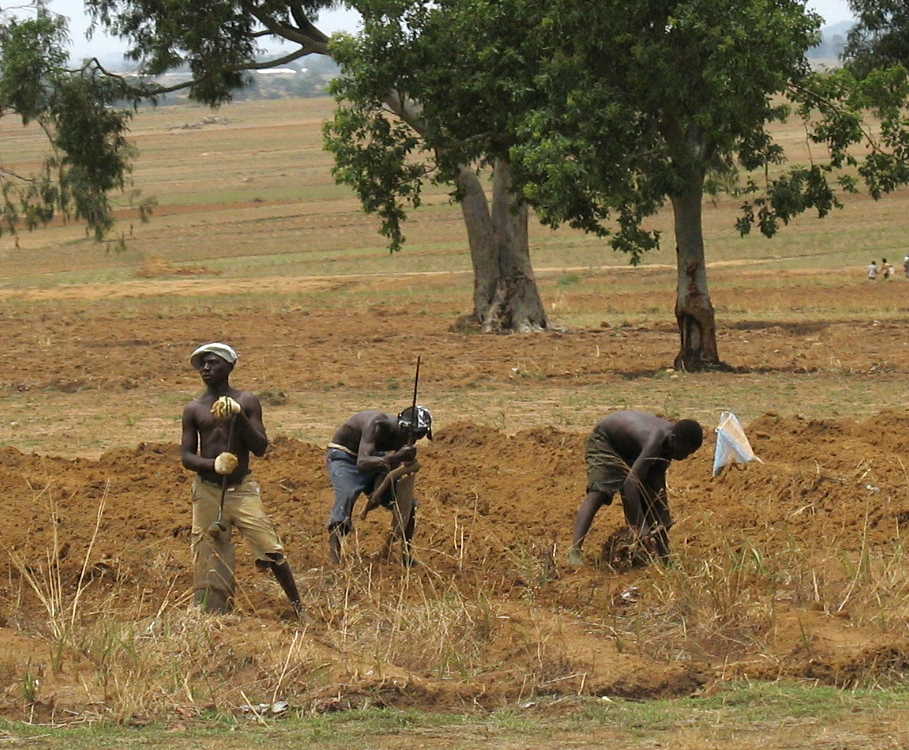
Photo: Nigerian farmers working in a field in the Middle Belt. Credit: Mike Blyth/Wikimedia Commons, CC BY 2.5.