


By Boluwatife Adedokun
For many smallholder farmers, finding a buyer can be almost as important as producing the crop.
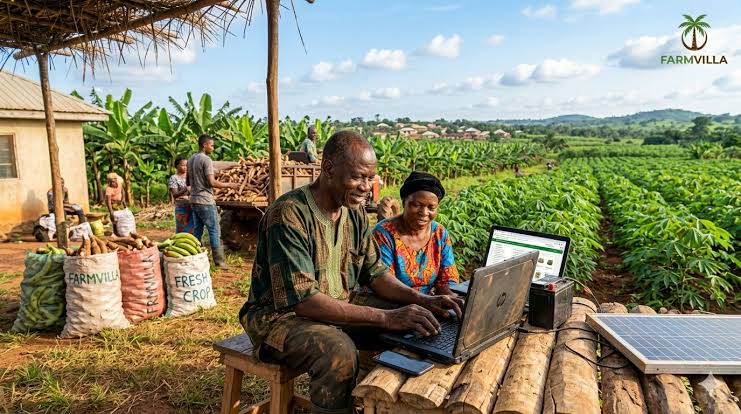
A farmer may spend months preparing land, buying inputs, planting and harvesting, only to face a difficult decision when the produce is ready: accept the price offered by the trader who has arrived at the farm or risk waiting for another buyer. With mobile phones becoming more common in farming communities, digital marketplaces are now emerging as another possible route to buyers.

The idea is straightforward. Instead of depending entirely on the trader who comes to the farm or the nearest physical market, farmers can list their produce online, indicate the quantity available and connect with buyers looking for specific commodities. In Nigeria, new digital agricultural platforms are being developed around this model, while government-backed initiatives have also begun exploring digital marketplaces as part of efforts to improve market access and strengthen agricultural value chains.
The market-access gap
The opportunity is significant because digital agricultural services have expanded in Nigeria, but farmers are not using all of them equally. A 2025 study by 60 Decibels, based on 1,374 Nigerian farmers during the 2023-24 agricultural season, found that two in five farmers had used at least one digital agricultural service. Information and advisory services were the most commonly used, while digital services for selling farm produce remained far less common.
According to the study, 65% of the farmers surveyed sold their produce, but only 4% used digital solutions to do so. Most relied on traditional market traders, local buyers or farm-gate sales. The findings are important because they show that the challenge is no longer simply getting farmers to use phones or digital services. The bigger question is whether digital agriculture is reaching farmers at the point where they need it most: when they have produce to sell.
Why the selling point matters
Farmers do not always have the luxury of waiting for the best possible price. Perishable crops such as tomatoes, pepper and leafy vegetables can lose value quickly, while farmers who borrowed money for production may need immediate cash to repay debts or prepare for another planting season. This can leave them with little bargaining power when buyers arrive.
Previous reporting has shown how this problem can affect farmers during periods of glut. In a 2025 report by Vanguard, a tomato farmer described how surplus production created difficulties in moving his harvest, with a digital platform providing an additional market for the produce. The experience illustrates an important point about digital marketplaces: their value may not necessarily be in eliminating existing buyers, but in giving farmers another route to the market when their usual channels are not enough.
A digital marketplace is more than an online notice board
For the technology to be useful, simply putting farmers and buyers on the same website is not enough. A functioning agricultural marketplace needs reliable information about what is available, where it is located, the quantity, quality and expected price, as well as a way to arrange payment and transportation.
This is why some Nigerian platforms are attempting to combine market access with other services. In 2025, the Federal Ministry of Agriculture and Food Security announced the launch of the Sovereign AgroTrade System, a digital agricultural marketplace that includes an online trading component alongside financial services, certification and farm-management tools. The stated aim is to connect farmers with buyers and financial services while improving their participation in agricultural markets.
The development of such platforms reflects a wider shift in agricultural technology. Digital tools are increasingly being used not only to provide farmers with information about production, but also to connect different parts of the value chain. A 2026 study on digital technology and e-commerce among rural Nigerian farming households found that at least 88% of the households studied were willing to use digital marketing platforms, although their willingness to pay for the service varied.
The technology does not automatically guarantee a better price
There is, however, an important warning for farmers and policymakers. Finding a buyer online does not automatically mean getting a higher price. The buyer may still negotiate aggressively, transportation costs may reduce the amount the farmer ultimately receives, and a farmer may struggle to meet the quantity or quality requirements of a larger buyer.
A digital platform can improve access to information and create additional opportunities, but the final price will still depend on supply, demand, quality, location, transportation and the bargaining relationship between the parties. This is why claims that digital platforms will simply “remove middlemen” should be treated carefully. Traders and aggregators often perform functions that include collecting produce from scattered farms, arranging transportation, providing short-term finance and moving commodities to larger markets.
The more realistic opportunity is to give farmers more choices. If a farmer can compare offers from different buyers instead of relying on a single buyer, the farmer may have a stronger position when negotiating. That does not eliminate the need for traders; it can make the market more competitive by improving the information available to the farmer.
Digital literacy remains a major barrier
Access to the technology is another challenge. A farmer may own a mobile phone but still find it difficult to navigate a digital marketplace, upload a product listing, compare offers or complete an online transaction. Poor internet connectivity, the cost of data, unfamiliarity with digital platforms and lack of awareness can all limit adoption.
The 2026 study published in the Journal of Integrative Agriculture found that fewer than half of the rural farming households studied demonstrated strong digital technology knowledge. It also found that digital knowledge was associated with farmers’ willingness to use and pay for e-commerce services.
This means that building a digital marketplace without helping farmers understand how to use it could leave many of the intended beneficiaries behind. Training, simple interfaces, local-language support and assistance through cooperatives or extension workers could make the technology more accessible, particularly for older farmers and those with limited digital experience.
The phone may be more important than the app
For grassroots farmers, digital agriculture does not necessarily have to mean downloading a sophisticated application. The 60 Decibels study found that farmers using digital agricultural services often accessed them directly through their mobile phones, with phone calls playing an important role.
This offers an important lesson for agricultural technology developers. A platform designed only for farmers with smartphones and reliable internet access may have limited reach in rural communities. Services that combine websites and smartphone applications with SMS, USSD, voice calls and human agents could potentially reach a much wider group.
For farmers in communities where internet connectivity is unreliable, being able to receive a buyer’s offer through a simple message or speak with an agent may be more useful than navigating a complex application. Technology should therefore fit the farmer’s environment rather than requiring the farmer to fit the technology.
Transportation could determine whether the platform works
Even when a farmer finds a buyer online, the transaction is not complete until the produce reaches the buyer. This makes logistics one of the biggest tests for digital agricultural marketplaces.
A farmer in a remote community may find a buyer several kilometres away, agree on a price and still lose much of the expected gain if transporting the produce is too expensive. Poor rural roads, fuel costs and the lack of organised aggregation can make small individual deliveries uneconomical.
This is why digital market platforms are more likely to produce meaningful results when they are connected to aggregation and logistics.
If several farmers can combine their produce and arrange transportation together, the cost per farmer can potentially fall while buyers receive larger and more predictable supplies. Recent work on Nigeria’s agricultural digitalisation has similarly highlighted the importance of connecting farmers, buyers, logistics and other parts of the value chain rather than treating online trading as a stand-alone service.
What farmers can do now
Farmers interested in digital marketplaces do not necessarily have to abandon the traditional markets they already know. A more practical approach is to use digital platforms as an additional source of market information and buyers.
Before listing produce, farmers can compare prices from several sources, check the identity of potential buyers and establish the quantity and quality requirements. They should also calculate transportation, packaging and platform charges before accepting an offer. A price that appears higher online may not be more profitable after all associated costs are considered.
Farmers can also benefit from working through cooperatives or producer groups. Instead of individual farmers listing small quantities, a cooperative can aggregate produce, maintain records and negotiate with larger buyers. This can make digital trading more attractive to buyers who require consistent volumes and can also reduce the logistical burden on individual farmers.
What government and technology companies need to address
For digital agricultural marketplaces to become useful beyond a relatively small group of farmers, the surrounding infrastructure has to improve. Affordable internet access, rural connectivity, digital literacy, reliable payment systems, agricultural extension and better roads are all part of the equation.
Government programmes also need to measure outcomes rather than simply counting how many farmers have been registered on a platform. The important questions are whether farmers actually use the service, whether they reach new buyers, whether transaction costs fall, whether post-harvest losses decline and whether farmers retain more income from their produce.
Technology companies, meanwhile, need to design around the realities of smallholder agriculture. Farmers may need voice support, local languages, offline functions, simple registration and assistance with logistics rather than another complicated application. Trust will also be essential. Farmers and buyers need confidence that the people on the other side of a transaction are genuine and that payments and deliveries can be completed safely.
From finding buyers to building stronger markets
Digital marketplaces are unlikely to solve every problem facing Nigerian farmers, but the early evidence shows that they can address one important gap: connecting farmers to information and potential buyers beyond their immediate surroundings. The fact that only 4% of surveyed Nigerian farmers who sold produce used digital selling services shows both how limited adoption currently is and how much room there is for growth.
The bigger opportunity is not to replace the traditional agricultural market with an online one. It is to combine digital tools with the systems farmers already use. Better information can help farmers compare prices; aggregation can help them reach larger buyers; digital payments can make transactions easier; and logistics can help move produce from remote farms to markets.