


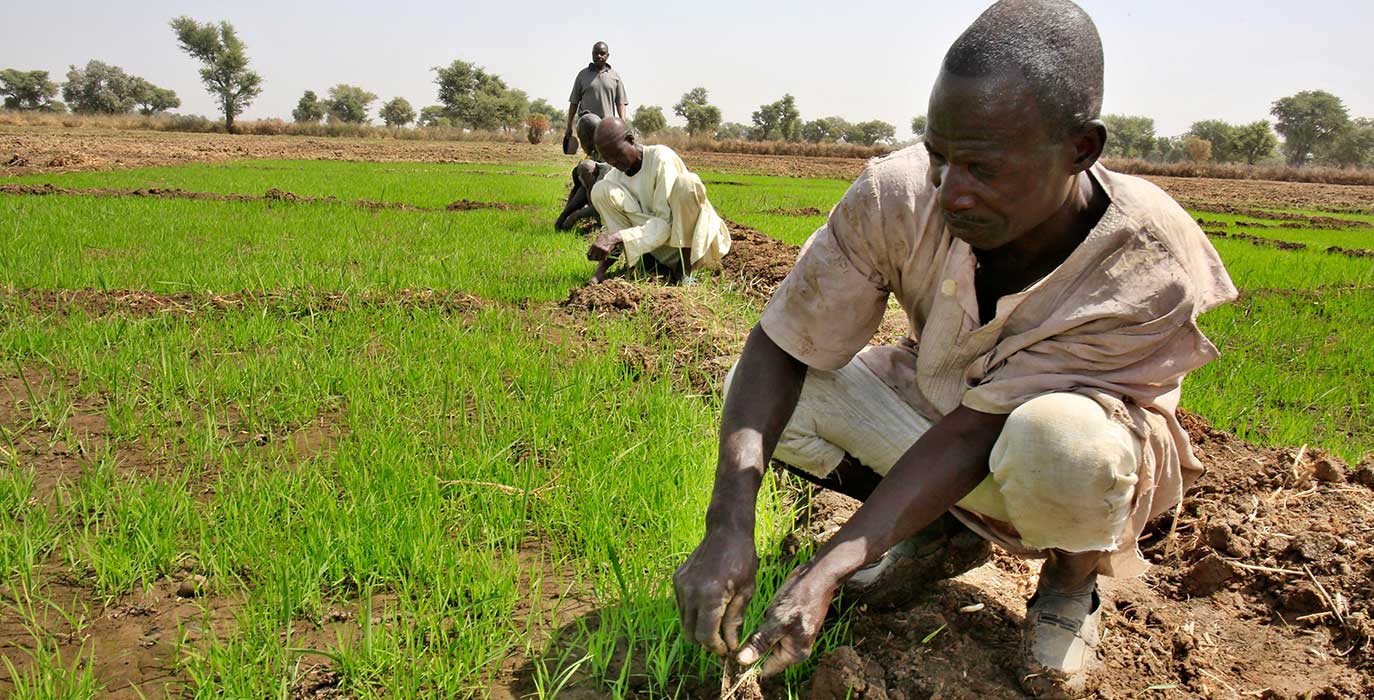
Nigeria’s rice shortfall is not just about how much farmers grow.
Nigeria’s rice debate often returns to the same promise: produce more locally, reduce dependence on imports and bring prices within reach of consumers. But a recent call by the Nigeria Governors’ Forum for better agricultural data points to a problem beneath the production targets. The country still needs a more reliable picture of how much rice is grown, processed, stored and consumed — information that should guide decisions on imports, investment, milling and support for farmers.
At the launch of the Northwest Nigeria Rice Diagnostic Report, the Forum’s Director-General, Abdulateef Shittu, said Nigeria consumes about 8.6 million metric tonnes of rice annually while domestic production stands at approximately 3.3 million tonnes. The figures were reported by Voice of Nigeria and The PUNCH. The Forum identified inconsistent production estimates, fragmented farmer and miller records and incomplete market information as barriers to planning.


The numbers need to be compared properly
The difference between the reported figures is striking, but it should not automatically be treated as the precise quantity Nigeria must import. Before policymakers use them to set targets or justify interventions, they need to establish whether production and consumption are measured on the same basis and over the same period. Rice statistics can refer to paddy harvested at the farm, milled rice after processing or rice available to consumers. Those measures are not interchangeable.
Milling removes husk and bran, so the weight of milled rice is lower than the weight of paddy harvested. Estimates can also differ in their treatment of stocks, seed use, losses, informal cross-border trade and the period used to calculate consumption. If one figure measures paddy and another measures milled rice, subtracting one from the other can produce a misleading picture of the supply gap.
This is not a reason to dismiss the Governors’ Forum’s warning. It is a reason to take its data concerns seriously. Without consistent records across farmers, processors, millers and markets, governments cannot confidently identify where the shortfall occurs or which intervention would have the greatest effect.
More production will not fix every weakness
Even when farmers increase output, the value chain can lose efficiency between the field and the consumer. Access to quality seed, fertiliser, machinery, irrigation and extension advice affects yields. Insecurity and high input costs can make cultivation more expensive or prevent farmers from planting. After harvest, inadequate drying, storage, transport and processing can reduce the quantity and quality of rice that reaches the market.
Nigeria’s National Rice Development Strategy II (2020–2030) recognises that mechanisation in production and processing is constrained by affordability, maintenance, local adaptation, weak business models and limited access to finance. It calls for better access to equipment, operator training, farmer clusters and sustainable private-sector-led machinery services. The challenge is not simply to announce another production target; it is to make the machinery, services and infrastructure work for farmers and processors.
The FAO’s overview of Nigeria’s agricultural sector also lists limited irrigation, inadequate financing, post-harvest losses, high production costs and weak input distribution among the sector’s structural constraints. A farmer may produce more but still earn little if transport is costly, the crop is poorly dried or local millers cannot process it efficiently.
Policy uncertainty affects farmers and millers
The Governors’ Forum also identified policy changes and poor coordination as problems. For rice farmers and investors, uncertainty can affect decisions made months before harvest. Farmers need to know whether inputs will arrive on time and whether irrigation, extension and credit services will be available. Millers need predictable access to paddy, power, finance and markets. Sudden changes in import rules or public procurement can alter prices and investment calculations across the chain.
The diagnostic should therefore lead to a public, measurable action plan. States need comparable data on planted area, yields, harvest volumes, paddy purchases, milling capacity, processing losses and market prices. The figures should be updated regularly and their definitions published so researchers, businesses and farmers can understand what is being counted.
A useful national rice dashboard would distinguish paddy from milled rice, show production by state and season, record mill capacity and utilisation, and track the movement of rice from farms to wholesale and retail markets. It should also explain how formal trade figures relate to informal cross-border flows and stock changes. Independent researchers and industry groups should be able to test the estimates.
The new report offers an opportunity to connect federal policy with state-level realities, particularly in the Northwest. But reliable data will not itself lower prices or raise yields. It can help governments target irrigation, extension, finance and infrastructure more effectively — provided the findings are acted upon and implementation is monitored.
Nigeria’s rice challenge is not simply a contest between local production and imports. It is a test of whether the country knows what is being produced, whether farmers can grow it competitively, whether processors can handle it efficiently and whether consumers can afford the final product. Until those questions are answered with consistent evidence, claims about rice self-sufficiency will remain difficult to assess.
These questions are also central to Harbinger’s analysis of why farmers struggle to find markets: production targets cannot be separated from the information and infrastructure that connect farms to buyers.