

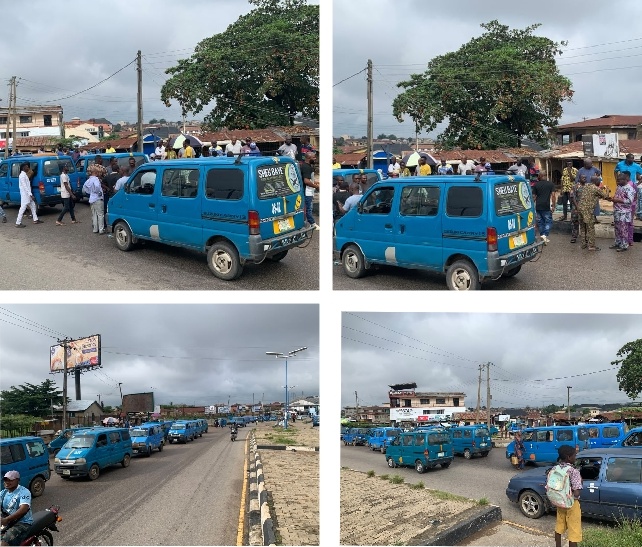
By 8am on Wednesday, the usual movement of commercial minibuses around Ayetoro in Osogbo, Osun State, had slowed.
Instead of moving from one street to another in search of passengers, several minibus drivers had parked their vehicles by the roadside. Their protest was not only about the latest increase in the price of petrol. It was also about what they said was becoming an increasingly difficult business to sustain.
The drivers, popularly known as Korope operators, had temporarily withdrawn their vehicles from the roads to draw attention to the rising cost of fuel, expensive spare parts and the growing cost of running their businesses.

For some of them, the calculation is becoming difficult. Money made from transporting passengers is quickly consumed by fuel, vehicle maintenance and other daily expenses, leaving little for the drivers themselves.
One of the protesters, Adewumi Adeleke, said some drivers now spend as much as N40,000 on petrol in a day.
“How could you be running this business, spending about N40,000 on fuel a day, and when you get home, all you see is just N5,000 or N3,000? Spare parts and everything are too costly, so we are not comfortable with the situation,” he said.
For Adeleke and others, the problem is not simply the amount paid at the filling station. It is the shrinking income left after the cost of keeping the vehicle on the road has been deducted.
Another driver, Prince Olakunle Ojo, described a similar situation, saying a driver could spend about N15,000 on petrol and end the day with earnings of only about N13,000.
“By the time you buy fuel worth N15,000 in the morning and, at the end of the day, you are able to make N13,000, the fuel money is not there, your food money is not there, and you cannot take care of the vehicle,” Ojo said.
The search for an alternative
As petrol becomes more expensive, some drivers have looked towards Compressed Natural Gas as an alternative.
But for Osogbo operators, the challenge is not only converting their vehicles. They also need somewhere to refuel them.
The drivers said Osun State currently lacks a CNG station where converted commercial vehicles can conveniently obtain the fuel.
Ojo said some drivers who had already converted their vehicles were unable to make full use of them because of the lack of refuelling facilities in the state.
“There is no single station in Osun State. Many people who have CNG in their vehicles are just keeping it there because Osun State does not have any station we can point to and say this is where you can get CNG,” he said.
The operators therefore want both the Federal and Osun State governments to accelerate the provision of CNG facilities in Osogbo.
For them, access to the alternative fuel could reduce the cost of operating their vehicles and make commercial transportation more sustainable.
But the drivers also want help with the cost of conversion, saying many operators cannot independently afford to convert their vehicles from petrol to CNG.
A fare that no longer covers the cost
The pressure on the drivers has also revived an old question: how much should passengers pay for transportation when the cost of providing the service keeps rising?
The operators are calling for a review of transport fares to reflect the current price of petrol, spare parts, maintenance and other operational expenses.
Their demand, however, comes at a time when passengers are also dealing with higher living costs.
Increasing transport fares means another financial burden for commuters who depend on commercial minibuses to get to work, school, markets and other destinations.
This puts drivers and passengers on opposite sides of the same economic pressure. While drivers say the current fares are becoming unsustainable, commuters have to find ways to pay for every increase.
The drivers say they are not asking to make excessive profits. Rather, they want fares that allow them to cover their expenses and still have something left after a day on the road.
Beyond fuel
For some operators, the problem goes beyond petrol.
Ariyo Idowu said the rising cost of maintaining vehicles and meeting family responsibilities had made the business increasingly difficult.
He also called for the provision and improvement of designated bus stops across Osogbo, saying proper transport infrastructure would help organise commercial transportation and improve movement within the city.
The demand for better infrastructure adds another layer to the protest. For the drivers, reducing the cost of transportation is not only about lowering petrol prices. It also involves creating an environment where vehicles can operate efficiently and passengers can move around the city without unnecessary delays.
The warning
The drivers have warned that they could withdraw their services for a week if their concerns are not addressed.
Such a move would affect thousands of commuters who rely on minibuses for daily movement around Osogbo.
For now, the drivers are asking for dialogue with the government and transport unions.
Their protest has placed a familiar problem back in the spotlight: when the cost of operating public transportation rises faster than drivers’ earnings, someone eventually has to bear the cost.
For the minibus operators, that burden has become difficult to carry alone.