


By Boluwatife Adedokun
Agriculture Summit Africa 2026 is set to bring together policymakers, investors, financial institutions, agribusinesses, technology providers and development partners in Abuja as stakeholders seek to accelerate Africa’s transition from a major food importer to a global agricultural powerhouse.
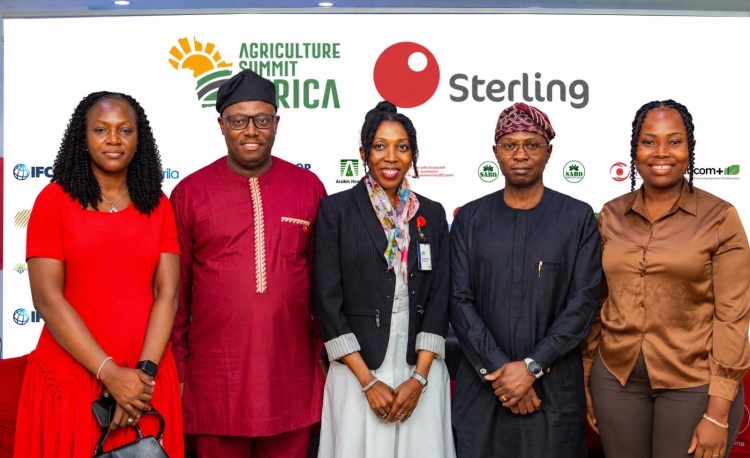
The ninth edition of the summit, organised under the theme “Building the Next Superpower: Africa’s Food Power Play,” is scheduled to hold on September 15 and 16, 2026. The event, convened by Sterling Bank, was unveiled at a press conference in Lagos attended by representatives of the public and private sectors.

The summit is coming amid concerns over Africa’s dependence on food imports despite the continent’s vast agricultural potential. Organisers said population growth and climate change are increasing pressure on food systems, while inadequate financing, infrastructure and market access continue to limit the ability of farmers to translate production into sustainable incomes.
Speaking at the event, Dele Faseemo, Group Executive, Corporate and Investment Banking at Sterling Bank, said agriculture remains central to the bank’s HEART strategy, which covers Health, Education, Agriculture, Renewable Energy and Transportation.
He disclosed that Sterling’s financing across the sectors rose by 39 per cent in 2025 to ₦331.7 billion, with agriculture recording one of the strongest increases.
Dr Olushola Obikanye, Group Head, Agric Finance and Solid Minerals at Sterling Bank, said Africa possesses roughly 60 per cent of the world’s uncultivated arable land but continues to spend tens of billions of dollars annually importing food. “Food is jobs. Food is trade.
Food is foreign exchange, industrial policy, climate resilience, and increasingly, geopolitical power. Hence, the continent that feeds itself and competes globally will hold real strategic weight. That is Africa’s food power play,” he said.
Stakeholders at the summit also identified access to finance, quality inputs, mechanisation, storage, logistics and markets as major challenges facing Nigerian farmers, alongside high post-harvest losses.
They stressed that addressing the challenges would require sustained collaboration between government, financial institutions, private businesses, development organisations and technology providers.
Christian Mulamula, Principal Country Officer for Nigeria at the International Finance Corporation, said agricultural transformation must extend beyond increasing production to creating an ecosystem where farmers and agribusinesses can access finance, technology, inputs, infrastructure and markets. He described ASA as a platform for connecting stakeholders and mobilising investment to strengthen Africa’s food systems.
The two-day summit is expected to feature high-level plenary sessions, investment and deal-making sessions, innovation showcases and cross-border trade discussions, with organisers positioning the event as a platform for turning conversations around Africa’s agricultural potential into practical investments, partnerships and measurable outcomes.