


By Boluwatife Adedokun
In Eti-Oni, a farming community in Atakunmosa East Local Government Area of Osun State, Janet Abbey, the Iyalode of Eti-oni still struggles to forget the day a pregnant woman from neighbouring Ido Aladodo reportedly died after she could not be transported to a hospital in time.
For the Iyalode of Eti-Oni, it was more than another tragic incident. It was a painful reminder of what residents say has become the reality of living in communities connected by a road that has become increasingly difficult to navigate.

“On Monday, we couldn’t even take our goods to the market because the road was bad. A pregnant woman in Ido Aladodo died because nobody could take her to the city on time,” she said.
The circumstances surrounding the woman’s death could not be independently verified. But residents across several communities in Atakunmosa East described similar difficulties, including delayed access to healthcare, accidents, rising transportation costs and problems moving farm produce to markets.
From Eti-Oni to Adido, Aladua, Ipaola, Odogbo-Ijesha, Aladodo, Alarere and other neighbouring settlements, farmers, traders, traditional rulers and community leaders said the deteriorating road has affected daily life and economic activities.
Residents now describe the road linking their communities to Ilesa and other commercial centres as a “death trap”.
The road was expected to receive a new lease of life when rehabilitation work began in 2024. Instead, residents said the project was left incomplete.
Project That Raised Hope
When construction equipment arrived in 2024, residents said they believed years of neglect were finally coming to an end.
The project signboard inspected during reporting identified the Federal Ministry of Works as the awarding authority and Messrs. Sailthrough Construction Limited as the contractor.
Residents said the contractor mobilised to the area, carried out preliminary work on portions of the road and began work on some bridge sections.
But the work did not continue to completion.
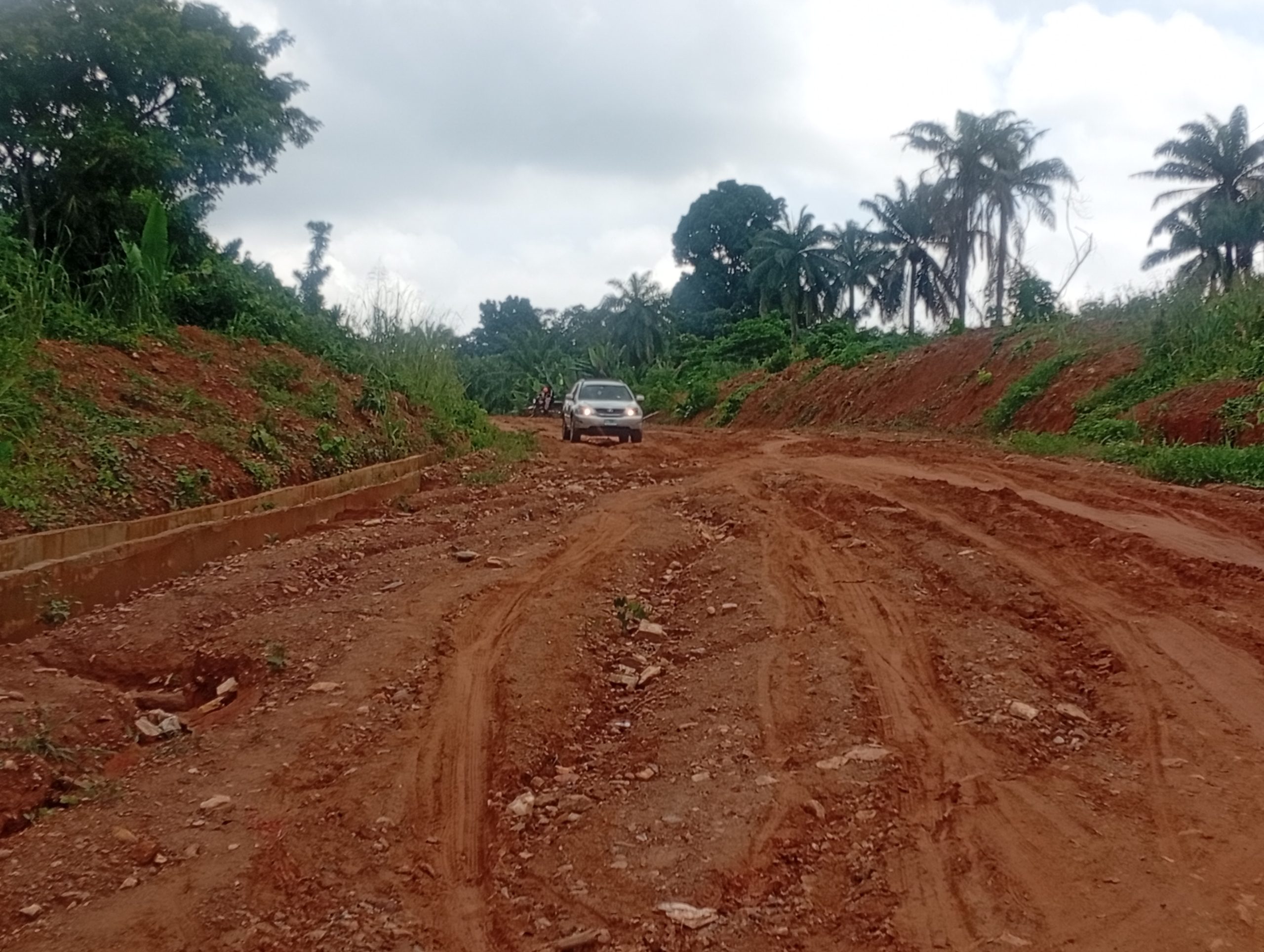
Heaps of granite, unfinished drainage structures, excavated portions and partially completed bridge works remain along sections of the route, according to residents.
Adebiyi Adejuwon, Secretary of the Ipaola Community, recalled the excitement that greeted the beginning of the project.
“We were happy when they started the work in 2024. They filled parts of the road and spread granite, but they never completed it. They also started work on one of the bridges and abandoned it. Now the road is even worse than before,” he said.
The unfinished portions, residents said, have deteriorated further during the rainy season, with erosion and mud making movement more difficult.
For communities that had waited for years for the road to be rehabilitated, the incomplete work has created renewed uncertainty over when the project will resume.
When the Rain Comes
Residents said the condition of the road becomes particularly severe during heavy rainfall.
Cocoa farmer Sunday Abiodun said some villages become difficult to access when rain persists.
“Sometimes rain falls for three days and no motorcycle can enter the village. We have witnessed countless accidents because the road becomes extremely slippery,” he said.
For residents, motorcycles have become an important means of transportation because commercial vehicles no longer operate regularly along some sections.
The difficult terrain, however, means even motorcycle operators sometimes avoid the route.
Temitayo Ibikunle, a motorcyclist who operates in the area, said the condition of the road affects both riders and their motorcycles.
“I don’t like plying this road. It damages our motorcycles. If passengers cannot pay enough, I simply won’t go,” he said.
Residents said the situation becomes more difficult for people who need to travel urgently, particularly pregnant women, elderly people and those seeking medical attention.
Farmers Carry the Burden
The communities affected by the road are predominantly agricultural.
Cocoa, cassava, maize, plantain, vegetables and other crops are produced in the area and transported to Ilesa and other markets.
But farmers said getting their produce out of the communities has become increasingly difficult.
Salam Rasheed, the Baale of Adido-Ijesha, said the road directly affects farmers’ livelihoods.
“The road is affecting our farm produce. Since they stopped the work, everything has become more difficult. It would have been better if they had not started at all than to leave it like this. Once it rains, people cannot pass.”
Azeez Bello, the Baale of Aladua, said the withdrawal of commercial buses has also affected the movement of goods.
“If buyers come, there are no buses. Motorcycles carry both passengers and farm produce, but the fares are very high. Because of that, buyers purchase fewer goods,” he said.
According to residents, the higher cost of transportation reduces the amount of money farmers are able to make from their produce.
They also said buyers sometimes reduce the quantity they purchase because of the difficulty involved in moving goods from the villages.
For communities whose livelihoods depend largely on farming, residents said the condition of the road has therefore become an economic problem as well as a transportation challenge.
“They Made It Worse”
In Odogbo-Ijesha, the Odofin of the community, Chief Benjamin Arogundade, said residents had hoped the rehabilitation would improve movement.
Instead, he said, some portions have become more difficult to navigate.
“The work they started has made the road worse. During the rainy season, movement becomes almost impossible. We only want the contractor to return and complete what was started,” he said.
The same concern was raised by the Baale of Adido-Ijesha, who said residents would have preferred the road to remain untouched rather than have construction begin and stop midway.
Residents said unfinished sections have become vulnerable to erosion, while the rainy season continues to worsen the road.
A Bridge That Cut Off Communities
The road problem is also linked to the condition of bridges connecting some of the communities.
Dauda Oyebode, Chairman of the Fruit Sellers Association in Eti-Oni, popularly known as Ya Lateef, said the collapse of the bridge linking Alarere and neighbouring communities has affected movement and commercial activities.
“The roads have been bad for years, but the rainy season has made them worse because of erosion,” he said.
Oyebode’s concerns were also reflected in an October 2024 report on the communities, when residents complained about poor roads and a collapsed bridge affecting movement and farming activities.
The bridge problem, residents said, has added to the difficulty of transporting people and goods between the affected settlements.
Residents Turn to Self-Help
With the road still in poor condition, some communities have resorted to temporary measures.
Former Chairman of Atakunmosa East Local Government and APC State Treasurer, Hon. Femi Kujembola, said some residents contribute money among themselves to carry out repairs on portions of the road.
Others, he said, have been forced to use longer alternative routes to reach Ilesa.
While Kujembola is a member of the opposition APC, residents and community leaders interviewed across the affected settlements independently raised similar concerns about the state of the road and the need for the project to be completed.
Their request is for the completion of the existing rehabilitation project.
Years of Complaints
The complaints over the road did not begin with the abandonment of the 2024 rehabilitation work.
In October 2024, residents of Etioni and neighbouring communities publicly appealed for urgent intervention over deteriorating roads and collapsed bridges, saying the condition of the route was affecting movement and agricultural activities.
At the time, residents also complained about the difficulty of transporting farm produce and the rising cost of movement.
The latest complaints come as the unfinished rehabilitation project continues to deteriorate.
Residents said the road remains important because it connects several farming communities to Ilesa, a major commercial centre in the area.
For farmers, traders and other residents, its condition determines how easily they can move people and goods in and out of their communities.
Waiting for the Contractor
The project signboard inspected during reporting identified Messrs. Sailthrough Construction Limited as the contractor handling the Federal Government rehabilitation project.
Residents said the contractor left after carrying out preliminary work and that no substantial work has continued on the affected portions.