


By Boluwatife Adedokun
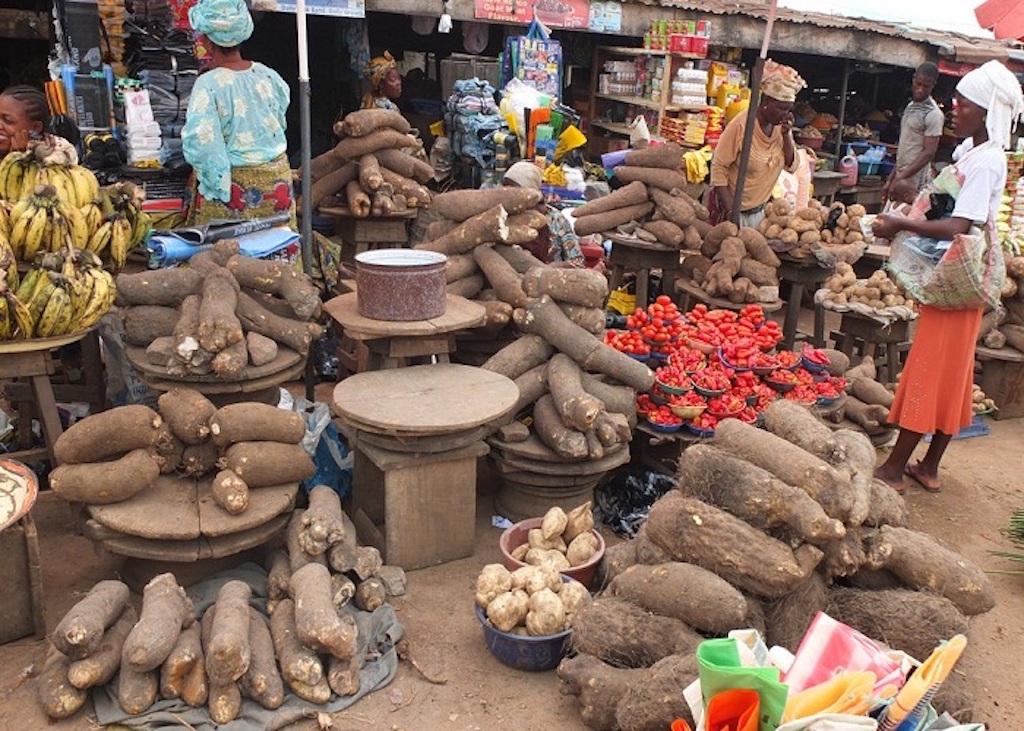
Nigerian households are contending with rising food and energy costs as prices of key commodities continue to climb amid persistent agricultural challenges, supply chain pressures, and environmental degradation.
According to CJID report, Fresh data from the Food Price Monitor covering April 25 to May 1, 2026, shows notable increases in the prices of staple food items and household energy products, deepening concerns over food affordability across the country.

Related Posts:
- Gas Price Crisis Takes Toll on AAUA Students
- Harvesting the Sun: Adamawa’s Farmers Embrace Solar…
- Nigeria’s Food Future at Risk as Climate Change…
- Food Inflation Rises to 12.12% in February as Input…
- People No Longer Take Bikes; They Trek Instead —…
Powered by Contextual Related Posts
Rice, one of Nigeria’s most widely consumed staples, recorded a 3.6 per cent increase, rising from N55,000 to N57,000 per 50kg bag. Similarly, beans also saw upward adjustments, with white beans increasing by 4.2 per cent from N120,000 to N125,000, while brown beans rose by 1.6 per cent from N128,000 to N130,000.
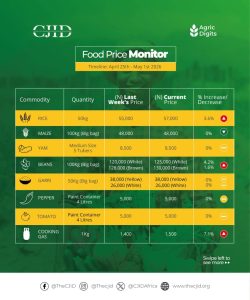
Cooking gas recorded the highest percentage increase within the period, rising by 7.1 per cent from N1,400 to N1,500 per kilogram, further intensifying household energy costs.
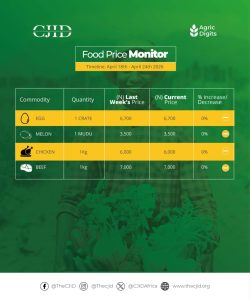
In contrast, prices of maize, yam, garri, pepper, and tomato remained stable within the review period. Likewise, protein sources such as eggs, chicken, beef, and melon maintained stable pricing in the preceding week (April 18 to April 24, 2026).
Beyond weekly fluctuations, broader indicators continue to reflect rising food insecurity. The latest “Jollof Index” shows that the cost of preparing a pot of jollof rice for a family of five rose to N30,435 in March 2026, driven largely by increases in fuel and transportation costs.
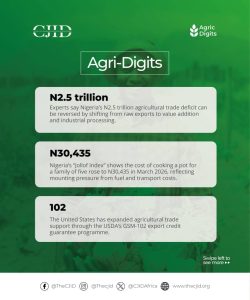
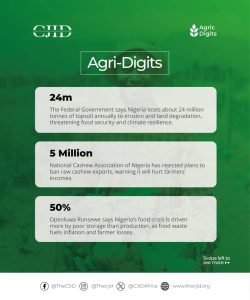
Experts attribute the persistent food inflation to structural inefficiencies within Nigeria’s agricultural system. Analysts warn that the country’s estimated N2.5 trillion agricultural trade deficit could be significantly reduced through value addition and increased local processing rather than reliance on raw commodity exports.
Environmental concerns further compound the crisis. The Federal Government estimates that Nigeria loses approximately 24 million tonnes of topsoil annually to erosion and land degradation, posing a long-term threat to agricultural productivity, climate resilience, and national food security.
Food policy experts also argue that post-harvest inefficiencies remain a critical driver of inflation. According to Opeoluwa Runsewe, Nigeria’s food crisis is less about production capacity and more about inadequate storage and distribution systems, which result in significant food waste and income losses for farmers.
Meanwhile, tensions persist within the agricultural export sector. The National Cashew Association of Nigeria has rejected proposals to ban raw cashew exports, warning that such a policy could negatively impact farmers’ earnings and disrupt the value chain.
The combination of rising commodity prices, structural agricultural weaknesses, and environmental degradation continues to place pressure on Nigeria’s food system, raising concerns about long-term food security and economic stability.