


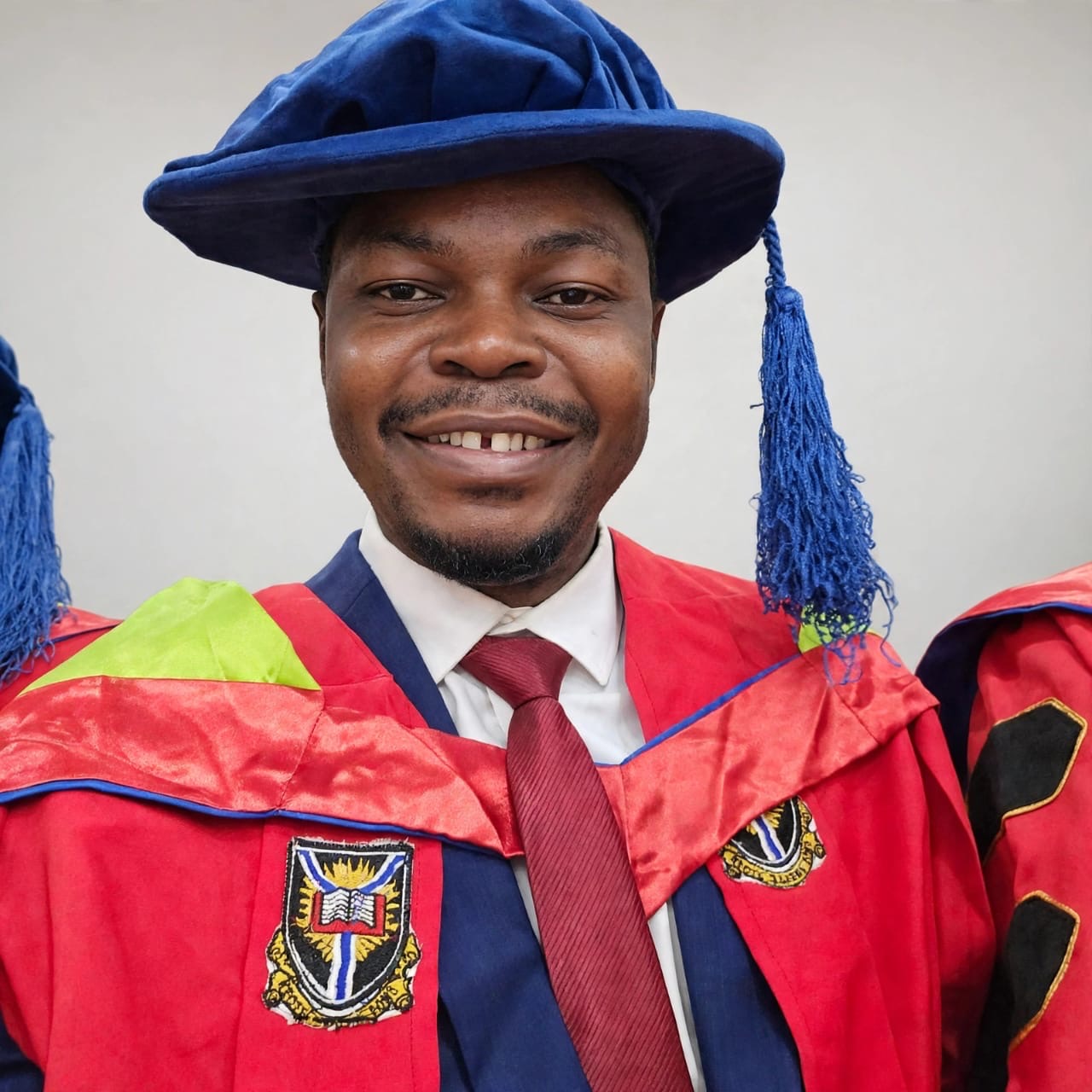
New PhD holder argues that humanitarian assistance must move beyond emergency relief to restoring livelihoods, dignity and self-reliance among displaced Nigerians
For thousands of families uprooted by conflict, displacement is not merely the loss of a home. It is the collapse of livelihoods, the interruption of children’s education, the disappearance of economic security and the uncertainty of how to rebuild a life after losing nearly everything.
In Benue State, where communities have endured recurring violence and displacement, the challenge facing internally displaced persons (IDPs) extends beyond finding temporary shelter or receiving food assistance. It is also about recovering the capacity to work, earn a living, provide for families and regain a sense of independence.

These realities formed the basis of doctoral research by Joel Abah, a lecturer and interdisciplinary researcher at the Department of History and International Studies, Prince Abubakar Audu University, Anyigba, Kogi State, whose work examines humanitarian emergencies in IDP camps in Benue.
Abah was recently conferred with a Doctor of Philosophy (PhD) in Peace, Security and Humanitarian Studies at the University of Ibadan after completing his doctoral programme in three years.
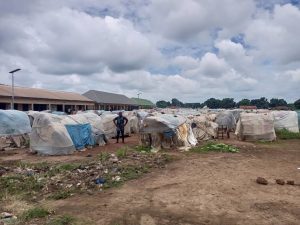
His research brings a development-focused perspective to displacement, arguing that humanitarian interventions cannot achieve lasting results if the conditions necessary for economic recovery, health and human dignity are neglected.
When families lose their means of survival
For many displaced households, the journey into displacement begins with the loss of the very resources that sustained their existence.
Farmers are separated from their land, traders lose their businesses, families abandon livestock and communities lose access to markets and social networks that supported their livelihoods.
Abah said prolonged displacement weakens household economies by depleting savings, disrupting productive activities and increasing dependence on external assistance.
According to him, many displaced people who previously depended on farming, livestock-related activities, petty trading and informal employment are forced to begin life again under difficult circumstances, often without the assets or opportunities required to rebuild.
Although some engage in casual labour, petty trading, small-scale farming and other survival activities, he said such efforts do not necessarily translate into sustainable economic recovery.
The situation, he noted, also affects host communities, as the growing population of displaced people places additional pressure on already limited healthcare services, schools, housing, infrastructure and local economic resources.
He argued that humanitarian response must therefore recognise displacement as an economic disruption with consequences for households, communities and government, rather than treat it solely as an emergency requiring temporary relief.
The connection between health and economic recovery
One of the central arguments of Abah’s doctoral research is that people’s ability to recover economically is closely linked to their living conditions.
Examining five IDP camps — Ichwa, Naka, Anyinn, Abagana and Daudu-II — his research focused on food, healthcare, shelter, and water, sanitation and hygiene (WASH).
He said these areas of humanitarian assistance are interconnected and cannot be effectively addressed in isolation.
Poor sanitation can expose displaced people to preventable illnesses, inadequate food can worsen malnutrition, poor shelter can increase vulnerability, while limited healthcare access can leave families unable to recover from sickness and participate in productive activities.
Abah argued that humanitarian organisations must adopt a more integrated approach to health security, recognising that the conditions of everyday living significantly influence people’s ability to rebuild their livelihoods.
He said the failure to address these interconnected needs could undermine the effectiveness of humanitarian programmes, even where individual interventions appear successful.
The problem of uneven humanitarian attention
The research also identified concerns about geographical disparities in humanitarian assistance.
Abah said displacement camps closer to Makurdi and its surrounding areas often enjoyed greater visibility and humanitarian attention than some camps located in remote parts of the state.
Although insecurity presents genuine difficulties for organisations attempting to reach affected communities, he warned that people in remote locations could suffer additional disadvantages because of their geographical isolation.
Such disparities, he argued, raise questions about how humanitarian resources are distributed and whether the most vulnerable populations are receiving assistance based on their needs.
He called for deliberate strategies to improve humanitarian access, stronger coordination with local institutions and community structures, and interventions that take account of the security and logistical realities of remote locations.
A humanitarian system that must plan beyond its presence
Another concern raised by Abah is the sustainability of humanitarian interventions, particularly when organisations reduce their operations or withdraw from displacement camps.
He said his research examined the consequences of reductions in support previously provided by organisations, including healthcare interventions associated with Médecins Sans Frontières (MSF) and food assistance linked to the International Committee of the Red Cross (ICRC) in some locations covered by the study.
According to him, the departure or reduction of services by established humanitarian organisations can expose displaced populations to further hardship when government institutions or incoming organisations are unable to sustain the same level of intervention.
He stressed that humanitarian transitions should not be treated merely as organisational exits but should involve clear plans for continuity of essential services, adequate resources, institutional responsibilities and realistic assessments of the capacity of organisations expected to take over.
The researcher said government must play a more decisive role in ensuring that humanitarian support does not collapse when international organisations reduce their presence.
He maintained that humanitarian organisations are partners in responding to displacement but cannot replace the state’s responsibility for protecting citizens and ensuring their welfare.
Research with a policy purpose
Abah said the motivation behind his research was to understand the extent to which humanitarian organisations’ objectives correspond with the actual experiences and expectations of displaced populations.
Rather than concentrating solely on what organisations provide, he examined how displaced people experience, interpret and assess the interventions designed for them.
He believes humanitarian programmes must give greater attention to the voices of affected populations, incorporating their priorities into programme design, implementation, monitoring and evaluation.
He also advocated stronger partnerships between government agencies, international humanitarian organisations, NGOs, civil society organisations and local actors to improve coordination, address gaps and reduce duplication.
For him, the objective should be to move humanitarian response from fragmented interventions to a coordinated system that recognises the relationship between emergency relief, protection, economic recovery and long-term development.
A doctorate earned through sacrifice
Abah’s academic milestone was achieved alongside his responsibilities as a lecturer and researcher, a combination he described as demanding considerable discipline and sacrifice.
He conducted his doctoral research without institutional funding, personally navigating the financial demands of his studies and fieldwork, including travels to displacement-affected communities and the challenges of conducting research under changing security conditions.
He said his conviction about the importance of the research, particularly the need to ensure that displaced people’s experiences were represented in policy and academic conversations, kept him motivated despite periods of exhaustion and uncertainty.
Abah attributed the achievement to God’s grace and acknowledged the support of his supervisor, Professor I. O. Albert, friends, colleagues, family members and his wife, Lydia O. Joel-Abah, whose encouragement and sacrifices, he said, were instrumental throughout the journey.
He defended his doctoral thesis on February 17, 2026, and completed the programme in three years.
The achievement is also significant for Kogi State, as Abah is reportedly the first person from the state to obtain a PhD in Peace, Security and Humanitarian Studies at the University of Ibadan.
His research is equally described as the first doctoral study in the department to focus exclusively on humanitarian emergencies in Benue State’s IDP camps.
From academic achievement to practical solutions
With the completion of his doctorate, Abah said he intends to expand his engagement with humanitarian policy and practice through publications, policy briefs, public lectures and dialogue with government institutions, development partners and civil society organisations.
He is also interested in further research into humanitarian governance, digital participation, everyday peacebuilding, citizenship and the role displaced communities play in their own security.
But the central message of his doctoral work is that the success of humanitarian intervention should not be determined merely by the quantity of relief distributed or programmes implemented.
Rather, it should be measured by whether displaced people are able to live healthier lives, recover their productive capacities, access meaningful support and rebuild the conditions necessary for independence.
For communities affected by displacement, the journey from emergency to recovery is often long and uncertain.
Abah’s research argues that the response must recognise that beyond surviving a humanitarian crisis, people need the opportunity to rebuild — economically, socially and with dignity.