

By Boluwatife Adedokun
The Osun State Police Command has identified misinformation and disinformation as major threats to the August 15 governorship election, announcing the deployment of intelligence operatives, Rapid Response Teams and a Joint Security Command Centre to prevent violence and ensure a peaceful electoral process.
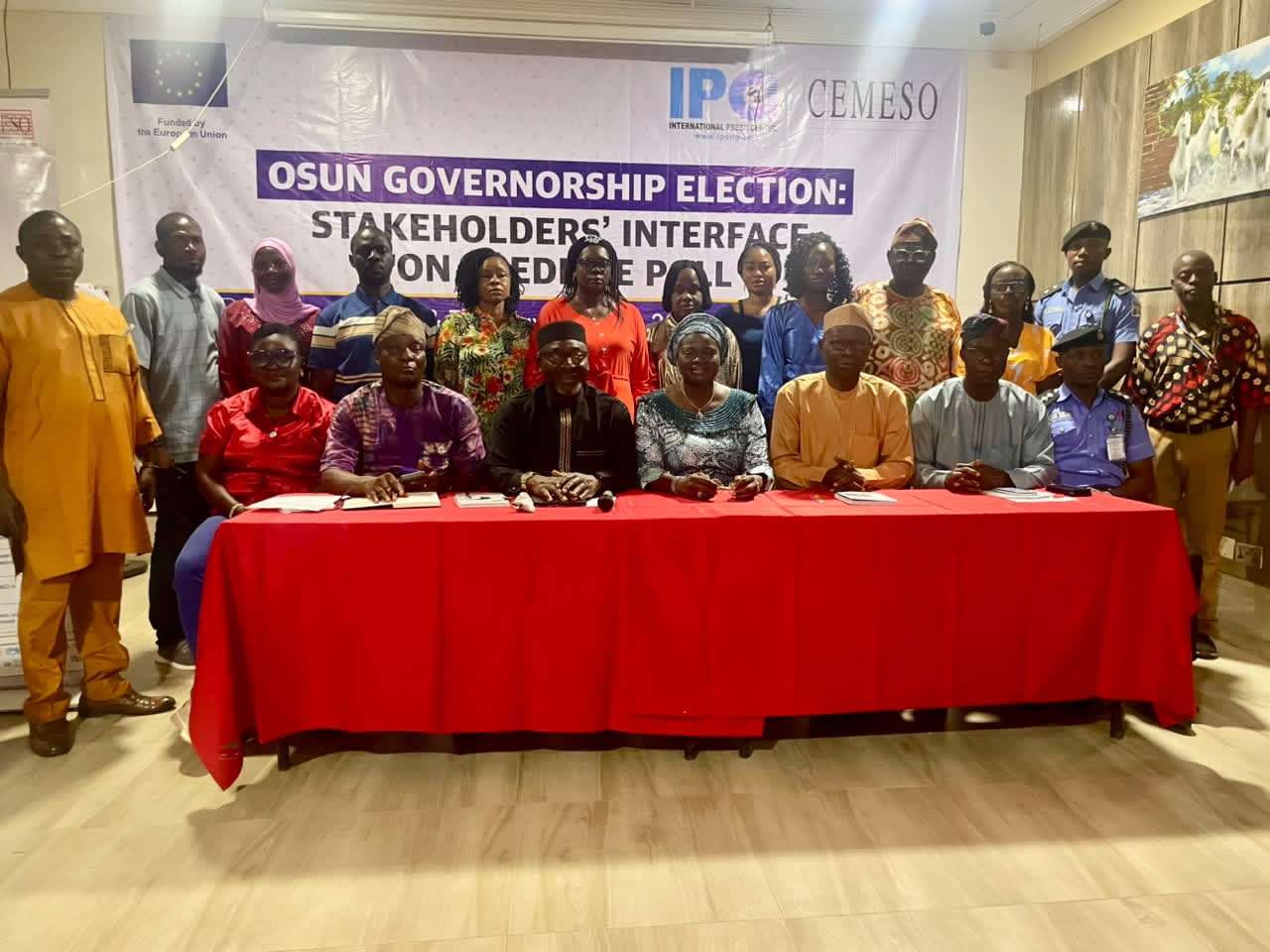
The Police Public Relations Officer, DSP Abiodun Ojelabi, who spoke on behalf of the Commissioner of Police, Ibrahim Gotan, disclosed this on Thursday during a two-day Media and Election Stakeholders’ Dialogue on Credible Governorship Election organised under the European Union Support to Democratic Governance in Nigeria Phase II (EU-SDGN II) programme by the International Press Centre (IPC) and the Centre for Media and Society (CEMESO) to strengthen media professionalism and promote credible electoral reporting ahead of the August 15 governorship election held in Osogbo.

Ojelabi warned that the rapid spread of false information, driven by emerging technologies including Artificial Intelligence, could create fear, confusion and mistrust among voters if not promptly addressed.
“We will react promptly to every misinformation. The police have identified flashpoints across the state, deployed intelligence and operational teams, and we are recording significant successes in addressing potential security threats,” he said.
He added that the command had established a Joint Security Command Centre involving the police, military, the Nigeria Security and Civil Defence Corps (NSCDC) and other security agencies to coordinate election security, while Area Commanders and Divisional Police Officers had been directed to sustain engagements with political actors at the grassroots to prevent violence before, during and after the election.
Also speaking at the event, the Resident Electoral Commissioner (REC) in Osun State, Mrs. Oluwatoyin Babalola, said the Independent National Electoral Commission (INEC) had completed about 95 per cent of its preparations for the governorship poll.
According to her, more than 95 per cent of non-sensitive election materials have already been distributed to local government offices across the state, while sensitive materials will arrive closer to election day in line with established procedures.
Babalola said the commission had substantially implemented most activities on its election timetable, revealing that the Continuous Voter Registration exercise recorded 381,817 new voters, while 50,747 transfer applications were processed, bringing the total number of applications handled to 499,809.
She added that INEC would soon announce dates for the collection of Permanent Voter Cards (PVCs), explaining that distribution would begin at registration areas before moving to local government offices to make collection easier for eligible voters.
The REC also disclosed that the commission had identified flashpoints and difficult terrains to strengthen security planning, while training for electoral officials, ad hoc staff and security personnel was ongoing.
“We are committed to conducting a free, fair, inclusive and transparent election. The success of this election is not the responsibility of INEC alone. It requires the collective commitment of security agencies, the media, political parties, civil society organisations and the voters themselves,” she said.
Stakeholders at the dialogue also called on journalists to uphold ethical and fact-based reporting ahead of the election. Executive Director of the International Press Centre (IPC), Lanre Arogundade, said the Osun governorship election would serve as a major test of the Electoral Act 2026 and the new leadership of INEC ahead of the 2027 general elections.
Similarly, Executive Director of the Centre for Media and Society (CEMESO), Dr. Akin Akingbulu, stressed that credible elections depend on a credible media, while the Chairman of the Osun State Council of the Nigeria Union of Journalists (NUJ), Dr. Adeyemi Aboderin, urged journalists to remain agenda setters through factual, balanced and responsible reporting.
The stakeholders’ dialogue was organised under the European Union Support to Democratic Governance in Nigeria Phase II (EU-SDGN II) programme by the International Press Centre (IPC) and the Centre for Media and Society (CEMESO) to strengthen media professionalism and promote credible electoral reporting ahead of the August 15 governorship election