

By Boluwatife Adedokun
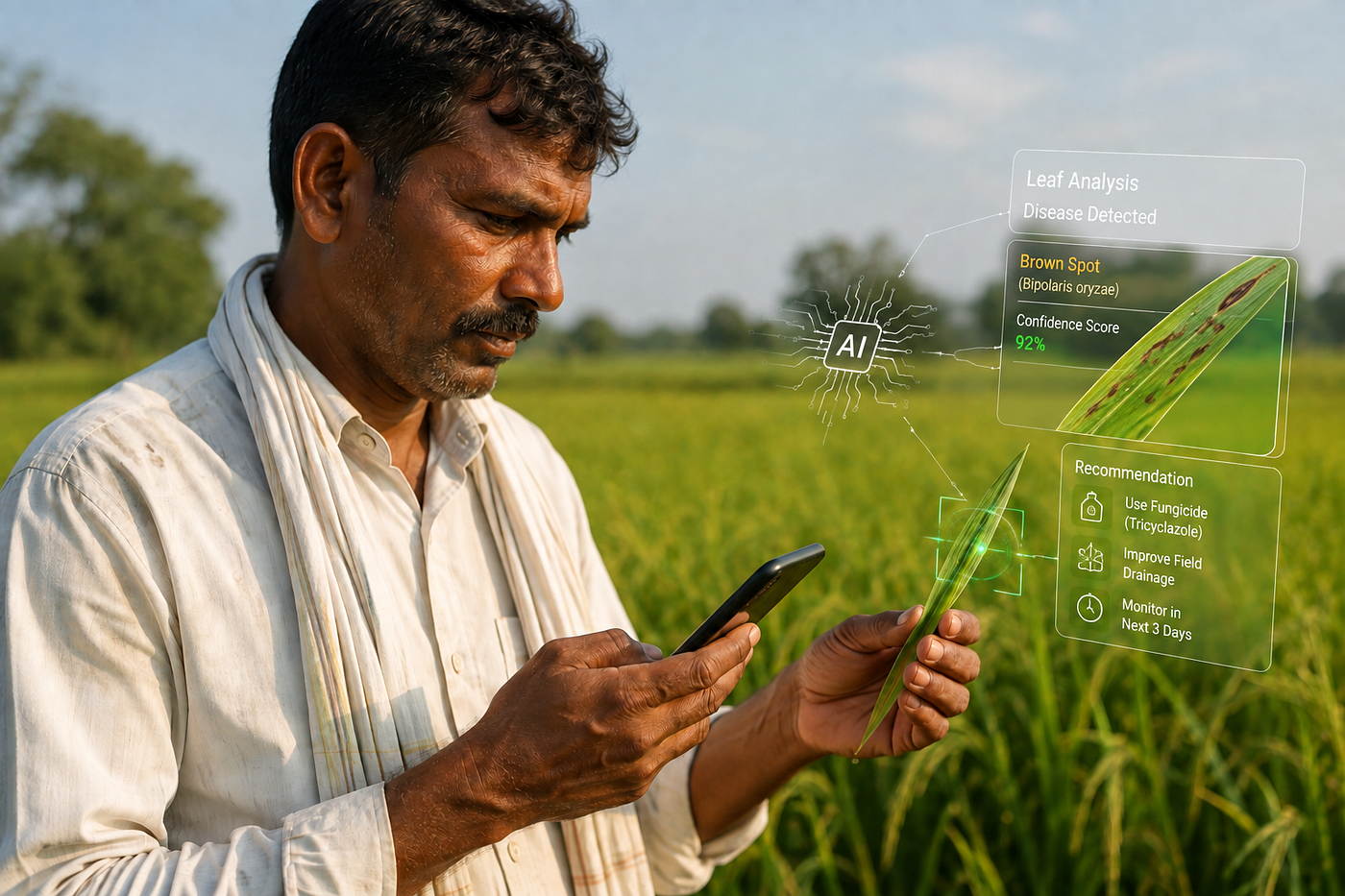
A farmer who notices unusual spots on a tomato leaf may have only a short window to determine what is wrong before the problem spreads across the farm. Traditionally, identifying crop diseases has depended on farmers’ experience, agricultural extension officers or visits to agrochemical dealers. But artificial intelligence is beginning to offer another option: taking a picture of an affected plant with a smartphone and using an AI system to suggest what may be wrong.
The technology is gaining attention in Nigeria as researchers and agricultural technology developers test smartphone-based systems that can identify crop diseases from images. For smallholder farmers, the attraction is straightforward. Earlier identification could mean earlier treatment, fewer unnecessary chemical applications and less crop loss. But emerging evidence also shows that the technology still faces problems around accuracy, internet access, cost and farmers’ ability to use it.

Turning a smartphone into a crop diagnostic tool
AI-powered crop diagnosis works by analysing photographs of leaves, fruits or other visible parts of a plant and comparing them with images of known diseases. Systems trained with large datasets can identify patterns associated with particular infections and provide a possible diagnosis or management advice.
Recent research is taking this technology beyond the laboratory. A September 2026 study on an AI-powered smartphone system for rice diseases developed a mobile application using a deep-learning model to detect four rice diseases, including bacterial blight, blast, brown spot and tungro. The system was also designed to provide farmers with disease-management advice.
Researchers in Nigeria are working on similar applications. A 2026 study on a mobile AI expert system called RiceAdvisor examined its adoption and usability among smallholder rice farmers in three major rice-producing states. The research involved 300 farmers in the adoption study and 120 participants in usability testing.
These developments show that AI-based diagnosis is moving towards practical agricultural use, rather than remaining solely a research concept.
Early detection could reduce avoidable losses
For farmers, timing matters. By the time a disease becomes obvious across an entire field, controlling it can become more difficult and expensive. Early identification can allow farmers to isolate affected plants, seek expert advice or begin appropriate treatment before the problem spreads further.
A 2026 study involving 150 crop farmers in Atiba Local Government Area of Oyo State provides an important picture of how farmers currently view this technology. According to the study published in the UNIZIK Journal of Engineering and Applied Sciences, farmers who used smartphone disease-identification applications reported benefits including earlier detection, reduced crop losses, improved yields and lower chemical costs.
The study also found that awareness remains limited. Although all the farmers surveyed either owned or had access to smartphones, only 47.3% were aware of smartphone applications for identifying plant diseases. Regular users accounted for 25.3%, while 52.7% had never used such applications.
The findings suggest that smartphone ownership alone does not guarantee that farmers will benefit from agricultural AI. Farmers must know that the technology exists, understand how to use it and trust the information it provides.
The accuracy question matters
One of the biggest concerns surrounding AI diagnosis is what happens when the system gets it wrong.
A photograph of a diseased leaf may look different depending on the lighting, camera quality, crop variety and stage of infection. Symptoms of different diseases can also appear similar. If an AI system incorrectly identifies a disease and recommends the wrong treatment, a farmer could spend money on unnecessary chemicals or delay the treatment actually needed.
This concern is reflected in the Oyo State study, where farmers identified concerns about diagnostic accuracy among the barriers to adoption. Poor internet connectivity, high data costs and low digital literacy were also identified as major constraints.
For this reason, AI diagnosis should not automatically be treated as a substitute for agricultural experts. A photograph can provide an early indication, but confirmation from an extension officer, agronomist or other qualified professional may still be necessary, particularly when the diagnosis is uncertain or the recommended treatment involves pesticides.
Nigerian developers are already testing local solutions
The technology is also beginning to emerge from Nigerian developers and research institutions.
One example is FarmLook, a Nigerian-developed platform that allows users to photograph affected crops and receive AI-generated disease identification and recommendations. The platform says it supports crops including maize, tomato and beans and provides a Hausa-language option, although it currently requires internet connectivity.
Another emerging platform, NomaApp, says it is developing AI-powered crop and pest diagnosis for African farmers, with support for crops such as maize, rice, cassava and tomato. Its developers also say the platform is designed for low-connectivity environments and includes local-language options such as Yoruba, Hausa and Igbo.
These platforms illustrate an important direction for Nigerian agricultural technology: developing tools around the conditions farmers actually face rather than simply importing technologies designed for completely different agricultural environments.
The technology must work where farmers work
Internet access remains one of the biggest practical questions. A farmer may have a smartphone but still be unable to upload a photograph from the farm because of poor network coverage or the cost of mobile data.
The Oyo study identified poor connectivity and high data costs as two of the leading constraints affecting farmers’ use of smartphone disease-identification applications. This means that an AI tool that works perfectly in an urban environment may be far less useful in a remote farming community.
Developers therefore need to consider low-data systems, offline functionality and tools that can process images without requiring farmers to maintain a constant internet connection. Local-language voice guidance could also make the technology easier to use for farmers who are more comfortable communicating in languages other than English.
AI cannot replace agricultural extension
Another issue is the shortage of agricultural extension support available to farmers. AI could potentially help bridge part of that gap, but it should not become a reason to further reduce human agricultural advisory services.
A research project on responsible AI innovation in African agriculture documented technology developed with Nigerian farming communities, including an AI-based real-time disease detection system and an e-extension application linking farmers with extension agents.
This model offers a more practical direction. AI can serve as the first point of assistance, helping a farmer identify a possible problem, while extension workers and agricultural experts can provide confirmation and more detailed advice. Such a system could allow limited extension resources to reach more farmers without removing the human support that many farmers still need.
Farmers need more than a diagnosis
Identifying a disease is only the first step. Farmers also need to know what they can safely and affordably do about it.
A useful AI agricultural service should therefore go beyond displaying a disease name. It should provide practical information about the seriousness of the problem, possible management options and when professional assistance is required. Where chemical treatment is recommended, farmers need clear guidance on appropriate products and safe application rather than simply being encouraged to spray.
This is particularly important because incorrect pesticide use can increase production costs and create health and environmental risks. A technology that encourages indiscriminate chemical use would not necessarily represent progress, even if its disease-detection accuracy is high.
What farmers can do now
Farmers who have access to smartphones can begin exploring reputable agricultural applications as an additional source of information when they notice unusual symptoms on their crops. However, they should avoid treating an AI-generated diagnosis as final, especially when the symptoms are severe or unfamiliar.
A clear photograph of the affected plant, taken in good lighting and showing both the damaged area and the wider plant, can improve the quality of an image-based assessment. Farmers should also keep records of when symptoms first appeared, the crop variety, recent weather conditions and any chemicals or fertilisers already applied.
Where possible, farmers should confirm uncertain diagnoses with agricultural extension officers, researchers or qualified agronomists before spending money on treatment.
The next step is making AI useful to the farmer
Artificial intelligence will not eliminate crop diseases, but it could change how quickly farmers recognise and respond to them. Research and emerging agricultural platforms in Nigeria show that smartphone-based diagnosis is becoming increasingly practical, while studies among farmers also reveal the barriers that could prevent widespread adoption.
The challenge now is to make these tools affordable, accurate and accessible beyond farmers who already have strong digital skills and reliable internet connections. More locally collected crop images, testing under real Nigerian field conditions, local-language support and stronger links with agricultural extension services will be important.
For smallholder farmers, the value of AI will ultimately not be determined by how advanced the technology sounds. It will be determined by whether a farmer can take a picture of a sick crop, get useful information early enough, understand what to do next and avoid losing money on the wrong treatment.
That is where agricultural AI can move from an interesting innovation to a practical farm tool.