


By Boluwatife Adedokun
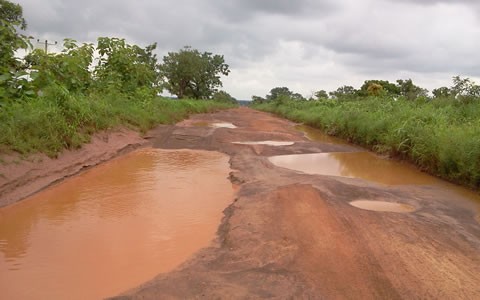
At dawn, Tajudeen Fawole stands beside his farm in Ila-Orangun, Osun State. He tightens a rag around his head, grips a heavy sack bulging with freshly harvested pepper, and begins a long, painful walk. The path he treads is not a proper road, it is a four-mile stretch of eroded earth, broken gravel and deep gullies. There is no vehicle; no motorbike wants to risk the journey. When a rider does accept the trip, he charges a fare most farmers cannot afford.
“Many times, we carry the produce on our head,” Tajudeen says softly, exhaustion heavy in his voice. “Otherwise, it will spoil before we get to any market.” He looks up at the trail, worn and wild, then adds, “They promised to fix this road many times but nothing changes.” The weight of the sack seems to press not just against his shoulder, but against the hopes of a community.

Tajudeen’s journey is repeated daily by dozens of farmers across Ila-Orangun , yet for them, each step is a gamble. A gamble that their harvest will rot in the sun, or that they’ll be robbed of their profit by transport costs. Their pain begins on the farm, but it ends on the road.
Rural Roads in Crisis
Nigeria’s rural road network is vast, but badly managed.
According to the Resettlement Policy Framework (RPF) for RAAMP, the national network covers approximately 194,000 km, of which 130,000 km are rural roads.
Yet over 80% of these local and rural roads are classified as being in fair or poor condition.
Even where roads exist, accessibility remains limited. The rural accessibility index, the share of rural population living within 2 km of an all-season road, stands at just 47%. In practical terms: more than half of Nigeria’s rural population cannot easily reach reliable roads.
The problem has escalated in recent years. In late 2024, the Federal Government and the World Bank approved a $500 million concessional loan (plus $100 million counterpart) to scale up RAAMP, targeting rehabilitation and maintenance of thousands of kilometres of rural roads.
Despite these efforts, a December 2022 assessment by the World Bank found that 87% of Nigeria’s rural roads remained “deplorable”, leaving only a fraction usable.
In Osun State, where Ila-Orangun is located, the state government’s own infrastructure records show that while there are over 6,200 km of local and rural roads under its remit, only 14% are under active maintenance at any given time.
This systemic neglect transforms rural roads from enablers of prosperity into barriers to basic economic survival
At a time when Nigeria and international partners are investing hundreds of millions of dollars under the Rural Access and Agricultural Marketing Project (RAAMP), the plight of rural producers like those in Ila-Orangun raises urgent questions: Why are critical farm-to-market routes still impassable? And what happens to agriculture if access remains broken?
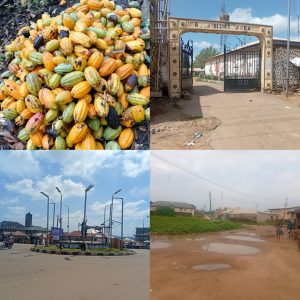
For Shittu Adeshina, another farmer in Ila-orangun who cultivates cocoa, cassava, kola nut and palm, the road has become the biggest threat to his livelihood.
Standing beside the heaps of produce he fears may never make it to market intact, he shook his head slowly.
“Erosion killed this road,” he said, voice heavy with resignation.
“We’ve been hearing promises for years, every election, every visit, but nothing happens. If we try to move our produce, it gets spoiled on the way, and when it doesn’t spoil, transport people collect all the profit. In the end, it’s like we worked for nothing.”
Further down the same battered stretch, Otunba Segun Awotunde, a major planter and former local government chairman, lives with the same frustration on a much larger scale.
With over 100 acres of palm, cocoa and maize, his operation depends on trucks that can no longer survive the journey.
“My lorries break down every time we try to move the harvest,” he said, pointing toward a parked truck with a cracked axle.
“During harvest season, transport is everything. But with this road, profit disappears into repairs. You load a truck today, and by the time it finally forces its way out of here, you’ve spent more on fixing the vehicle than you’ll make from the harvest.”
Farmers like Abdulyekin Tiamiyu, who grows cassava, maize and pepper, now struggle to even find transport willing to attempt the path.
“Vehicles don’t enter the farm area at all,” he explained. “So motorcycles increase their fares. Sometimes we spend more on transport than we earn from the harvest. That kind of thing kills motivation.”
Transporter Share Ordeal
For transporters, the situation is no different. Muhideen Adekeye, a commercial motorcyclist, said the road has turned everyday work into a gamble.
“They said the road would be built,” he muttered, “but they haven’t started anything. Our bikes spoil almost every week. Many riders don’t even agree to follow this route again, that’s why the price is high. If I don’t charge well, I’ll use all my income to repair the bike.”
Each voice carries the same bitter truth: the road is not merely inconvenient, it is destructive, swallowing income, produce, and morale.
What should have been a short, routine trip to the market has become a punishing journey filled with fear, risk and loss. For many in Kajola, crops rot before buyers can reach them, income vanishes into repairs, and every season feels heavier than the one before. Here, on this crumbling road, hope does not just fade, it erodes.
A History of Promises, Yet No Results
The current rural road crisis in Ila-Orangun is layered on decades of systemic failures. Since 2006, Nigeria has recognized rural mobility as central to poverty reduction and economic development under its National Policy on Rural Travel and Transport.
Building on that, the Rural Access and Mobility Project (RAMP-2), predecessor to RAAMP, included Osun State among four beneficiaries. It aimed to rehabilitate rural roads and improve transport systems for millions of rural residents.
In Osun, the administration of former Governor Rauf Aregbesola claimed to have rehabilitated hundreds of kilometres of state roads, and begun council-level road works.
But not up to a decade later, in communities like Ila-Orangun, the promised roads and maintenance schemes remain largely invisible. The paths that once connected farms to markets have reverted to rutted tracks, impassable after rains or even under heavy loads.
Even with RAAMP-SU now funded and targeting 6,500 km of rural roads for rehabilitation, plus the establishment of new road-maintenance agencies, it remains unclear whether remote farm tracks like Ila-Orangun’s will ever benefit.
Expert View: Why Road Maintenance Not Just Reconstruction Matters
Infrastructure experts emphasise that building new roads is only half the battle. Without sound asset management and regular maintenance, even newly built roads can quickly deteriorate, especially in rural areas exposed to heavy rains and heavy farm vehicles.
A broader analysis of rural access worldwide shows that improving rural road connectivity can significantly reduce poverty, increase access to education and markets, and accelerate economic inclusion.
In Nigeria’s context, analysts say that without consistent maintenance, institutional funding and transparency, large-scale rural road initiatives risk failing. The challenge is not just construction, it is long-term sustainability.