


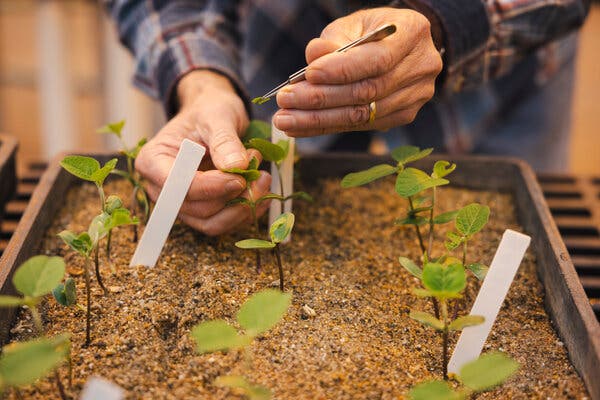
Federal funding cuts in the United States are raising alarm among scientists, agronomists, and food security experts, as critical research designed to safeguard global agriculture faces unprecedented uncertainty. The U.S. Agency for International Development (USAID), a key supporter of agricultural innovation worldwide, has scaled back or shuttered programs that once received over $150 million annually under the Feed the Future initiative.
The move, initiated under the Trump administration, has disrupted research efforts at U.S. universities and international centers, jeopardizing studies aimed at improving crop resilience, livestock efficiency, and sustainable farming practices. These initiatives were designed to protect the global food supply from threats such as soil depletion, evolving plant pathogens, and erratic climate patterns.
Impact on Universities and Global Agriculture

Related Posts:
- Climate Change and Agriculture: A Call to Action for…
- How Nigerian Farmers Are Struggling to Adapt to…
- How Grassroots Solutions Are Powering Climate…
- Smart Farming Techniques Nigerian Farmers Should…
- Harvesting the Sun: Adamawa’s Farmers Embrace Solar…
Powered by Contextual Related Posts
The funding cuts directly affected 17 labs across U.S. universities, including the soybean “innovation lab” at the University of Illinois Urbana-Champaign. Lab director Peter Goldsmith said, “It was lights-off in an instant,” after the lab, which had been developing high-yielding soybean varieties for West African farmers, had to lay off 30 staff members. Similar disruptions occurred at the University of Florida, where research on livestock nutrition and access to protein-rich foods was halted.
“Some of the most effective investments that USAID made over its entire history were in agricultural research and development,” said Keith Fuglie, chief economist of the nonprofit Food Security Leadership Council. Research shows that each dollar spent on agricultural science historically yielded more than ten dollars in economic benefits.
The funding cuts also jeopardized support for international research institutions such as the International Maize and Wheat Improvement Center (CIMMYT) in Mexico, which manages a seed bank of over 150,000 genetically unique types of wheat and corn. Bram Govaerts, CIMMYT’s executive director, said the withdrawal of U.S. funding left a $60 million gap, creating vulnerabilities for global food security and raising concerns about increasing reliance on private and foreign research, including from China.
“These issues transcend national identity. They are about humanity,” said Vern Long, former director of USAID’s agricultural research team. Experts warn that diminished public investment could lead to higher global food prices, hinder malnutrition reduction efforts, and exacerbate environmental pressures as farmers expand rather than intensify land use.
While a recent congressional proposal seeks to allocate $175 million to agricultural research in 2026, uncertainties remain over long-term federal support. Agricultural economists emphasize that resilient and sustainable food systems rely on stable public investment in research, alongside private sector contributions.
“Cutting back now is casting the die for the productivity performance in the 2030s and 2040s,” said Philip Pardey, professor of economics at the University of Minnesota. Experts warn that delays in research today may threaten global food security for decades.
As global challenges such as climate change and population growth intensify, analysts urge the U.S. and other high-income nations to recognize agricultural science as a strategic investment, essential not only for economic development but for human survival.