


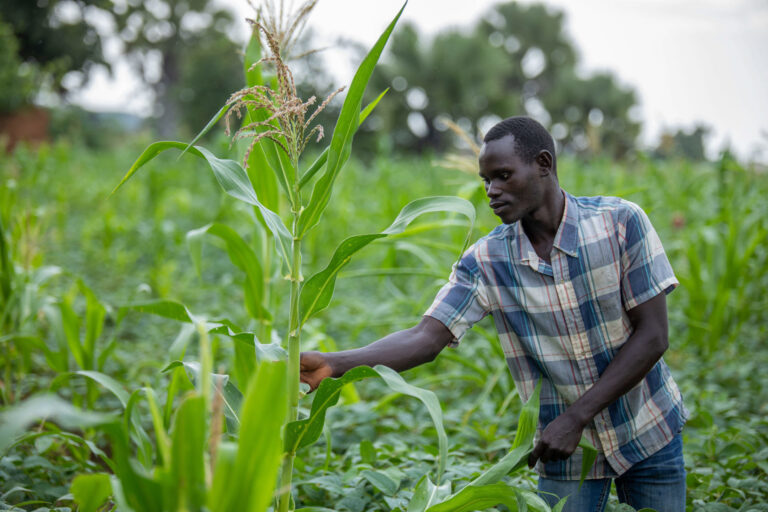
As Osun ramps up mechanisation and food production programmes, a crucial dimension of agricultural reform lies beyond tractors and inputs—who benefits and how deeply these benefits transform lives.
Mechanisation, public-private partnerships, and farm input distribution are intended to expand productivity and food security, but their socio-economic outcomes depend on whether they create meaningful opportunities for youth, women, people living with disabilities, and other marginalised groups in Osun’s rural economy.
The Osun government has taken visible steps to enhance productivity and food security, distributing tractors and inputs such as seedlings, herbicides, and cassava cuttings and committing billions of naira toward agriculture. Gov. Ademola Adeleke’s administration unveiled 31 tractors and distributed thousands of seedlings to farmers, including youths, women’s associations, and persons with disabilities, as part of efforts to ensure food security and boost agricultural output.

Related Posts:
- Osun’s Agro-Industrial Push: Can Mechanisation…
- Infractions Bothering on Employees’ Taxes & Payment…
- Surviving the Storm: Osun Palm Oil Producers Fight…
- Harvesting the Sun: Adamawa’s Farmers Embrace Solar…
- Osun Farmers Beg FG to Release LG Funds as Adeleke…
Powered by Contextual Related Posts
These initiatives aim to reduce drudgery in farm work and make agriculture less physically demanding, an important factor for young people traditionally discouraged from farming due to its labour intensity. The Commissioner for Agriculture has emphasised that equipment and inputs will be distributed through public-private partnerships to groups that include youths, women, and PWDs.
However, intent must be measured against outcomes. A vital question is whether youth participation is rising beyond subsistence farming into genuine agribusiness and entrepreneurial roles.
Traditional barriers like access to finance, land, and technical training continue to limit the ability of young agripreneurs to scale their activities or access value chains that pay sustainably.
Without structured financing schemes, affordable credit, and targeted training, youth may remain engaged only at the lowest rungs of agricultural endeavour, a situation that stifles innovation and economic empowerment.
For many rural youth, farming still competes poorly with urban opportunities, a challenge underlined by broader national trends where agriculture is often seen as low-status and undercapitalised.
Women farmers are another group whose economic inclusion is critical for food security. Rural women in Osun undertake a significant share of crop production and household food provisioning, yet they often have limited access to land titles, credit, and technology.
A study on rural Osun households found that women frequently diversify livelihoods to sustain food security, yet their access to agricultural inputs and financial support remains constrained.
Moreover, partnerships with organisations aimed at upskilling women farmers suggest an emerging recognition of this gap and the need to integrate women more fully into value-adding roles through mechanised processing, marketing, and agribusiness services.
Incorporating persons with disabilities into agricultural programming is also essential to meaningful inclusion. Osun’s distribution of resources explicitly included this group, which is significant because disability often compounds barriers to economic participation.
Yet inclusion demands more than nominal distribution; it requires adaptive technologies, accessibility in training, and support structures that enable full engagement in production, processing, and enterprise development.
Food security is the most tangible outcome against which these socio-economic goals can be evaluated. Osun’s agricultural committees and programmes emphasise improved food production, mechanisation, and market structures intended to ensure steady food availability.
But increased production must be paired with better storage, distribution, and pricing stability, or the gains from mechanisation could be diluted by post-harvest losses and market volatility. Crucially, food security outcomes should be measured not only by aggregate output but also by household access to food year-round, affordability, and nutrition—especially in vulnerable communities.
This context raises a central question: Is Osun creating an enabling environment where rural youth and marginalised groups can benefit economically from agriculture’s modernization, or are opportunities accruing mainly to better-resourced actors?
The presence of tractors and seedlings signals intent, but long-term inclusion requires targeted policy actions—such as access to credit, structured training and mentorship, land-access reforms, gender-responsive programmes, and deliberate efforts to measure food security outcomes at the community level.
If these socio-economic outcomes are realised, Osun’s agricultural transformation could shift from mechanised output to inclusive growth that supports livelihoods, reduces rural unemployment, and enhances food security for the most vulnerable households. But if the benefits remain tied to short-term distribution rather than sustained economic participation, the promise of agricultural modernisation may fail to deliver on its most important promise: shared prosperity and dignity for all participants in the agricultural economy.