


By Promise Eze
Despite constituting nearly half of Nigeria’s estimated 230 million people, women in the country continue to face significant barriers limiting their participation in leadership, politics, and governance.
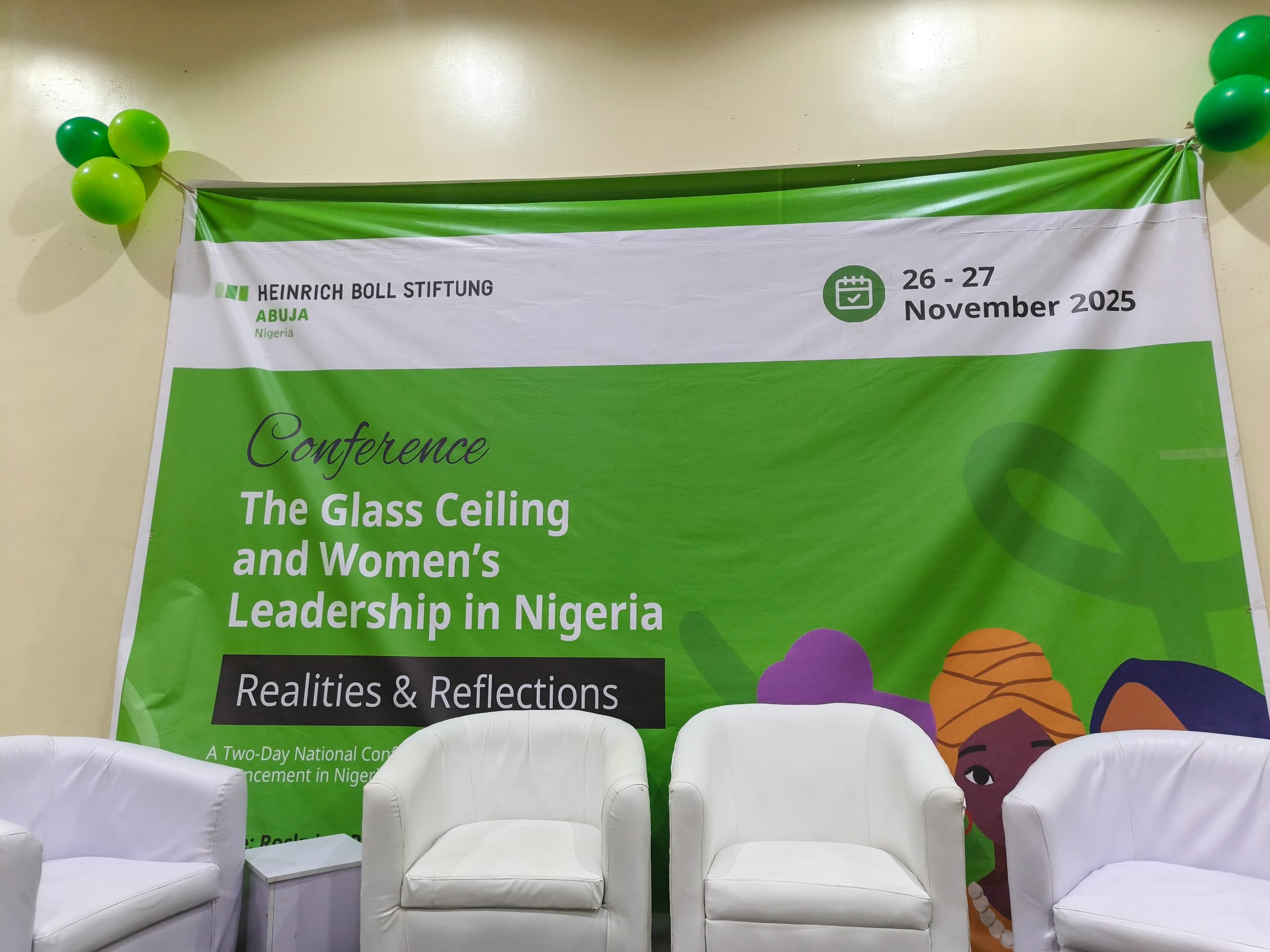
It was in response to these challenges that the Heinrich Böll Foundation (HBF) convened a two day conference aimed at advancing women’s inclusion and representation across Nigeria’s political sphere, media landscape and private sector.

The conference, held on 26 and 27 November, brought together women from diverse backgrounds, including gender advocates, feminists, students and farmers.
Speaking during a stakeholder engagement in Abuja on Wednesday, which had the theme “the glass ceiling and women’s leadership in Nigeria,” Sophie von Knebel, the Country Director of HBF, emphasised that Nigeria cannot achieve meaningful development without fully integrating women into leadership and decision making.
She observed that although women make up half of the population, they continue to face systemic barriers that restrict their access to leadership roles.
According to her, “Discussions around women’s leadership in this country are not new. Nigeria has produced extraordinary women across politics, civil society, academia, business, and the media — women whose achievements inspire and reshape what leadership can look like. Yet, despite these successes, the overall representation of women in political leadership remains low, and in recent years, has even declined.
The barriers and challenges have been analysed, discussed, and documented extensively. We will not solve them all today and we should acknowledge that openly. But what we can do today is contribute something meaningful by looking at a specific, often overlooked dimension: How can women support one another more intentionally to address the structural underrepresentation of women in leadership?”
Ere Amachree, Heinrich Böll Stiftung (HBS) Programme Manager for Rethinking Politics, noted that findings from two HBS supported studies, one on women’s political participation and another assessing the needs of market women in Oyo State, show that Nigerian women sometimes unintentionally or deliberately hinder one another’s advancement.
She stated that in some cases, women in leadership positions do not mentor others and may even act as gatekeepers who uphold patriarchal norms. This behaviour has at times led subordinates to call for their removal, further reinforcing the very glass ceiling that limits women’s upward mobility.
Amachree explained that scholars link these outcomes to long term stigmatization, marginalization, muted voices and the restrictive belief that there is only “one seat at the table” for women. As a result, some women become timid when they attain leadership roles while others become overly aggressive or hostile.
She explained that institutional restrictions, limited education, lack of financial resources for political engagement and even self exclusion contribute to women’s limited participation. She also challenged the widespread narrative that “women do not support women,” describing it as a divisive and harmful generalisation that ignores deeper societal and institutional forces.
Sharing a personal reflection, she recalled the influence of her first boss. She said, “She was a remarkably competent woman, quiet, thoughtful, the type of leader who spoke only when she had something important to say. But when she did speak, she hit the nail on the head. She believed in me at a moment when I was still unsure of myself.
She encouraged me to be bold in rooms full of more experienced professionals and to speak up and defend my ideas. Her support transformed my path, just as many of you have had women who shaped yours.”
She added that the conference was not only an opportunity to present survey findings but also a platform for honest dialogue, stronger networks of solidarity and the co-creation of practical, culturally grounded strategies to help young women step confidently into leadership roles.
According to her, “no woman breaks the glass ceiling alone. And if women do not intentionally support, mentor, and lift one another, the pace of progress will remain far too slow in Nigeria, in Germany, and across the world.”
Other stakeholders at the event echoed these views, noting that deeply rooted patriarchal norms and systemic barriers have long impeded women’s progress into leadership roles across sectors. They acknowledged that internal dynamics among women, including certain actions and inactions, can unintentionally hinder collective advancement.
They called for deliberate efforts to eliminate institutional restrictions and create environments that empower women in Nigeria to rise to leadership positions across all sectors.
Participants also shared that they intend to apply the knowledge gained from the conference in their various fields, adding that the discussions helped them better understand the realities women face in Nigeria.
One participant, Mary Alu said: “People use ‘woman’ as a measure of incompetence, and most times we don’t even realise it. That is what this conference set out to educate us on, to help us understand that sometimes even our language undermines women in leadership.”